
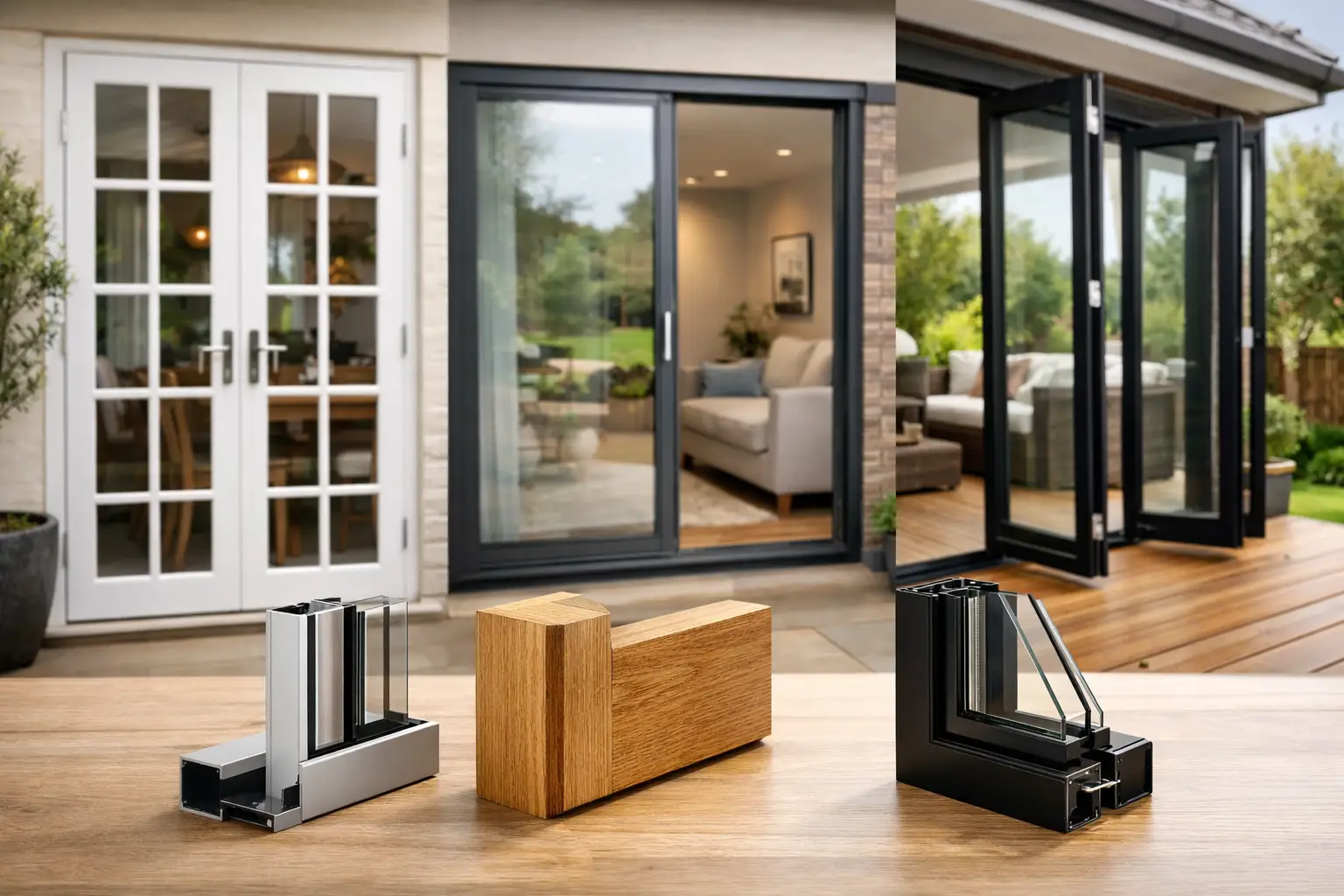
An extension can look exceptional on plan and still feel disappointing once built if the doors are wrong. Too much frame, a poor opening layout, or weak thermal performance will affect how the space works every day. When clients ask us about the best doors for extensions, the answer is rarely just about appearance. It is about how you want the room to open, how much glass you want to see, and how the system performs through a British winter.
What are the best doors for extensions?
For most modern extensions, the best doors for extensions are either aluminium bifold doors or aluminium sliding doors. Both give you large glazed openings, strong weather resistance and a cleaner connection to the garden than older-style patio or French doors. The right choice depends on whether you prioritise a full opening, minimal sightlines, day-to-day convenience, or budget control.
That trade-off matters. A system that looks perfect in a brochure may not suit the way the room is used. A family kitchen extension with regular traffic to the garden has different demands from a rear sitting room where the main goal is uninterrupted views.
Why aluminium usually makes the most sense
For extension projects, aluminium is typically the strongest all-round option. It allows slimmer frames than many alternative materials, supports larger panes, and handles frequent use well. With a thermal break and energy efficient glazing, it also delivers the thermal performance expected in a modern renovation or self-build.
There is a practical point here too. Extensions often aim to bring in more daylight and create a contemporary finish. Bulky framing works against that. Premium aluminium systems from established manufacturers give you the balance most buyers want – strong structure, refined aesthetics, security-tested hardware and reliable long-term performance.
Bifold doors for extensions
Bifold doors remain one of the most popular choices for rear extensions, and for good reason. They fold back to create a very wide clear opening, which is ideal if you want the kitchen, dining area and garden to feel connected in summer. If your priority is opening up the entire rear elevation, bifolds are hard to beat.
They also offer flexibility in configuration. You can choose where the traffic door sits, whether the leaves stack internally or externally, and how the threshold is set up depending on access requirements and weather exposure. That makes them especially useful for family homes and renovation projects where practicality matters as much as style.
Systems such as Smarts Visofold 1000 Bifold Doors, Schuco ASFD75 Bifold doors, Cortizo Bifold Plus and Origin OB49 Bifold Doors are often considered for extension work because they combine slim aluminium frames with proven performance. Higher-spec options such as ASFD90.Hi Bifold Doors may appeal where thermal targets are tighter or the project demands a more premium specification.
The compromise is straightforward. Bifolds have more visible vertical frames than sliding doors because of the number of door leaves. When closed, you will not get the same broad panes or the same minimal look. They are also more mechanically complex, so system quality, manufacturing accuracy and installation standards matter a great deal.
When bifolds are the better choice
Bifolds tend to suit wider openings where the whole wall needs to open up. They also work well on extensions used for entertaining, where direct movement between inside and outside is part of the brief. If you want that open-corner feel across a patio on warm days, bifolds are often the right answer.
They are particularly effective when the opening width is generous enough to justify the folding action. On smaller apertures, the benefits are less pronounced, and other door types may offer better value.
Sliding doors for extensions
If your priority is glass and view rather than a fully open aperture, sliding doors are often the stronger option. They give you larger panes, fewer frame interruptions and a more contemporary appearance when closed. For many extension designs, especially those with a strong architectural feel, that cleaner sightline is exactly what the space needs.
Premium sliding systems such as the Smarts Visoglide Plus sliding door, Schuco ASE60 Sliding Door, Schuco ASE80 Sliding Door, Cortizo COR Vision Sliding Door and Cortizo COR Vision Plus Sliding Door are designed for this kind of application. They can deliver impressive glass areas and smooth operation while maintaining good thermal performance and weather resistance.
The key limitation is that sliding panels move behind one another, so you never open the full width in the same way as a bifold. If half-open access is perfectly acceptable and you want to maximise glazing, that is often a worthwhile trade.
When sliding doors are the better choice
Sliding doors are usually the best fit for extensions where uninterrupted garden views matter most. They are also a strong choice for homes with a more minimalist design language, where slim sightlines and large panes carry more visual value than a complete opening.
They work particularly well in open-plan rear extensions that need strong daylight levels throughout the year. Even when shut, they keep the glazing dominant and the frame profile relatively discreet.
Are French doors ever the best option?
Sometimes, yes. French doors are not the headline choice for large contemporary extensions, but they still have a place. On smaller projects, side returns, utility extensions or openings where budget is more constrained, a pair of French doors can be entirely appropriate.
They offer a simple operation, a familiar appearance and a reasonable opening width without the cost or complexity of larger bifold or sliding systems. The downside is obvious – less glass, more frame and a less modern overall feel. If the extension is designed around maximum transparency, French doors usually will not deliver the effect you want.
The details that matter more than most buyers expect
Choosing between bifold and sliding is only the first stage. The real success of an extension door depends on specification. Sightlines affect how much glass you actually see. Threshold choice affects convenience, weather performance and accessibility. Glazing specification affects comfort near the doors in colder months.
Security should also be considered at system level, not as an afterthought. Well-engineered aluminium doors with approved components, quality locking systems and tested configurations offer far more reassurance than a cheaper product that simply looks similar online.
Then there is installation. Large glazed doors are only as good as the survey, manufacture and fitting behind them. Poor tolerances, weak preparation or careless finishing can undermine even a premium branded system. That is why experienced employed installation teams and product-specific knowledge make a material difference on extension projects.
How to choose the best doors for your extension
Start with the opening itself. If you have a very wide rear elevation and want to open most of it in good weather, bifold doors are usually the natural option. If your extension design is more focused on clean lines, large panes and a strong view out, sliding doors are often the better investment.
Next, think about daily use rather than the occasional summer weekend. Will the doors be the main route to the garden? Do you want a dedicated traffic door? Is there enough patio space outside for a threshold that suits the levels properly? These questions sound basic, but they shape how satisfied you will be once the extension is finished.
Budget matters too, but it should be judged against the scale of the opening and the importance of the feature. Doors are often the defining element of an extension. Saving modestly on the specification can have a very visible effect on aesthetics, thermal performance and lifespan.
For trade buyers and specifiers, the same principle applies in a more technical way. Product comparisons should look at panel sizes, sightlines, thermal values, threshold options, glazing capacity and approved configurations rather than headline price alone. That is where named systems earn their place.
Our view on the best option for most projects
If we are speaking broadly, the best doors for extensions are aluminium sliding doors for view-led contemporary designs and aluminium bifold doors for projects where the widest possible opening is the priority. Neither is universally better. The right system depends on how the space is meant to feel and function.
That is why extension door selection should never be reduced to trend alone. A well-specified Schuco, Cortizo, Smarts or Origin system can be an excellent choice, but only when matched to the opening, the architecture and the way the room will actually be lived in.
The best extension doors do more than look impressive on handover day. They make the room brighter in January, easier to use in July, and better to live with every single day.