
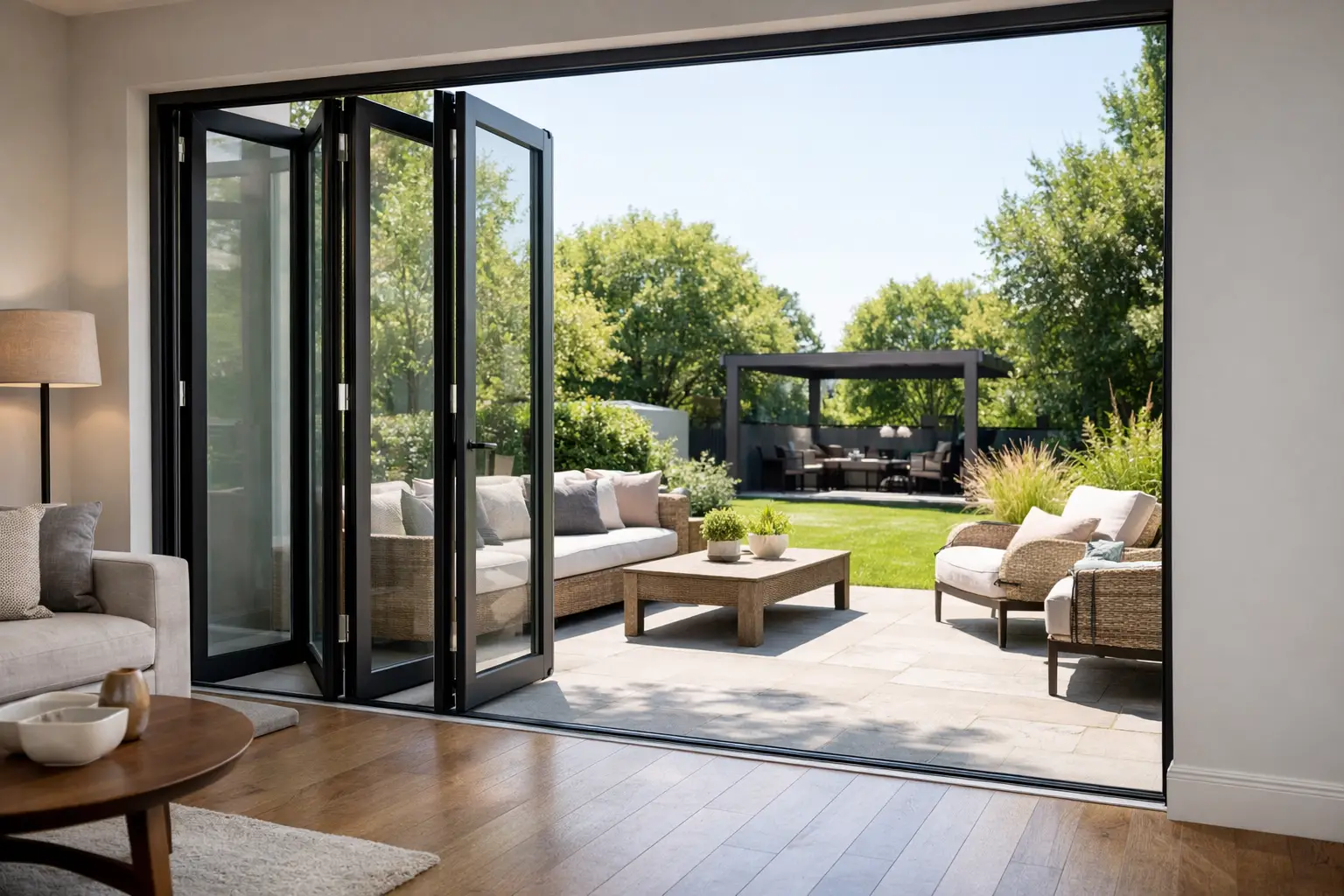
A standard bifold with a raised bottom track does the job. A flush track bifold changes how the opening feels. When the floor finish inside lines up closely with the threshold and the track sits lower into the cill or floor build-up, the result is a cleaner transition, a neater look and easier movement between house and garden. So if you are asking what are flush track bifolds, the short answer is this: they are bifold doors designed with a low, more level threshold detail to reduce the step over at the base of the opening.
That sounds simple, but the detail matters. In practice, flush track bifolds are not just about appearance. They affect accessibility, weather performance, drainage, floor construction and how early the door needs to be planned into the build.
What are flush track bifolds in practical terms?
Flush track bifolds are aluminium bifold door systems where the bottom track is recessed or specified with a low threshold detail so the internal floor and the threshold sit as close to level as possible. The aim is to minimise the lip at the doorway rather than leave a more obvious raised track above floor level.
On a well-designed project, that creates a more open connection to the outside and avoids the feeling of stepping over a chunky base frame every time you pass through the doors. For extensions, garden rooms and rear renovations, that detail can make a visible difference because the threshold line is exactly where indoor-outdoor living either feels easy or feels compromised.
It is also why flush track bifolds are often discussed alongside accessibility. A lower threshold can be better for children, older occupants and anyone moving trolleys, furniture or pushchairs through the opening. That said, not every flush threshold is fully level in the strictest sense, and not every low threshold is suitable for every exposure. The right answer depends on the system, the opening position and the drainage design.
How a flush threshold bifold door is built
With most bifold doors, the panels run on a bottom rolling track. On a standard arrangement, that track is more pronounced and projects above the finished floor level. On a flush threshold version, the installer and fabricator work with a threshold option that brings that track lower into the construction detail.
This usually means the structural opening, floor screed, external paving level and drainage all need proper coordination. If the threshold is chosen too late, you can end up with awkward level changes, poor water run-off or a door that looks lower and heavier than expected at the base.
Premium systems such as Cortizo Bifold Plus, Schuco ASFD75 Bifold doors and Origin OB49 Bifold Doors can be configured with low-threshold options, but the exact detail varies by manufacturer. That is why comparing brochures is only part of the process. What matters is how the actual threshold performs once fitted into a real opening with real weather exposure.
Why people choose flush track bifolds
The strongest reason is visual. A flusher threshold gives the whole opening a more refined look, especially in contemporary extensions where clients want slim aluminium frames, larger glazing areas and a clean floor line from kitchen to patio.
The second reason is usability. If you use the opening every day in summer, a reduced step is simply easier to live with. It helps when carrying food outside, moving between dining area and garden, or walking through barefoot without catching a toe on a raised track.
The third reason is planning for inclusive access. A low threshold can be part of a broader design approach where circulation through the home is made easier. For some projects, this is a lifestyle preference. For others, it is a practical requirement.
The trade-offs you should know about
This is where flush track bifolds need an honest explanation. Lower thresholds look better to many buyers, but the lower you go, the more carefully the weathering detail has to be handled.
A raised threshold gives you more protection against driven rain because the barrier at the base is more substantial. A flusher detail reduces that physical upstand. That does not mean it leaks. It means the surrounding design has to do more work. External drainage, paving falls, overhangs, exposure level and correct installation all become more important.
If the doors are on a sheltered rear elevation with sensible drainage, a flush threshold can work very well. If they are fully exposed on a coastal or elevated site facing prevailing weather, the threshold choice may need more caution. In those cases, a standard or slightly higher threshold may be the better technical answer, even if it is not the cleanest-looking option.
That is also why experienced suppliers do not treat threshold choice as a box-ticking upgrade. It should be assessed against the site, the system and the way the opening will be used.
What are flush track bifolds best suited to?
They are especially well suited to rear extensions, kitchen-diners opening onto patios, orangery-style spaces and garden-facing family rooms where day-to-day access matters as much as sightlines. In these settings, the threshold often becomes part of the selling point of the whole room.
They can also suit self-build projects where floor levels and threshold detailing are considered early enough to get the finish right. Architects and builders often prefer that approach because the cill detail, drainage and paving relationship can be designed in from the start rather than adjusted on site.
For renovation projects, flush track bifolds are still possible, but they may require more compromise. Existing floor heights, damp protection, patio levels and internal finishes can limit how flush the threshold can realistically be.
Flush track bifolds compared with standard bifold thresholds
A standard threshold is usually the more forgiving option. It tends to offer stronger resistance to water ingress in exposed conditions and can be easier to install where levels are less predictable. It may also cost less in some specifications because there is less site coordination involved.
A flush track threshold is usually the more design-led option. It improves the feel of the opening and often looks more premium, but it asks more from the build detail. You are effectively trading some simplicity for a better transition.
Neither is automatically right. For some homeowners, the cleaner threshold line is worth prioritising. For others, especially where the doors are more about views than regular access, a standard threshold is the smarter choice.
System choice still matters
Not all bifolds perform the same way just because they offer a low threshold. Frame design, thermal break quality, gasket detailing, maximum panel sizes, glazing specification and manufacturing accuracy all influence the result.
For example, if you want a premium aluminium bifold with strong thermal performance and a refined finish, systems such as Schuco ASFD75 Bifold doors or Cortizo Bifold Plus are often specified for that reason. If budget, lead times or configuration flexibility are driving the decision, options like Smarts Visofold 1000 Bifold Doors may also come into the conversation. The threshold detail should be assessed alongside the whole system, not separated from it.
That includes the glass. Aluminium products with thermal break technology and energy efficient glazing help support better overall thermal efficiency, but the threshold itself is still one part of the weather and heat-loss equation. Buyers sometimes focus heavily on sightlines and forget the bottom detail is one of the hardest-working parts of the door.
Installation is just as important as the door
A flush track bifold is not a product-only decision. It is an installation decision. Even an excellent door can disappoint if the base is not prepared correctly, the drainage is poor or the paving is set too high.
This is where specialist knowledge matters. The relationship between frame, packers, cill support, sealant zones, drainage paths and finished floor levels needs to be right. On supply-only jobs, that means clear drawings and careful coordination with the builder. On supply-and-install projects, it means having a team that understands threshold detailing rather than treating it as a standard fit.
For homeowners, the simplest rule is this: do not buy a low-threshold bifold on brochure appeal alone. Ask how the threshold will sit relative to internal flooring, external paving and drainage. That answer tells you more than a product image ever will.
Are flush track bifolds worth it?
If your priority is a cleaner transition to the garden and the opening is in the right location, yes, they often are. They can make the room feel better finished and more connected to the outside, which is exactly what many bifold projects are trying to achieve.
If your site is highly exposed, your external levels are awkward or the opening is not used as a main access point, possibly not. In those cases, a slightly more raised threshold may give you a better balance of durability and practicality.
The best approach is to start with the opening, not the buzzword. Ask how you want the doors to function, how exposed the elevation is and how the threshold will be detailed from slab to paving. Once those answers are clear, the right bifold system and threshold option become much easier to specify.
Get that detail right and flush track bifolds stop being a brochure feature. They become one of the reasons the whole room works better every single day.