
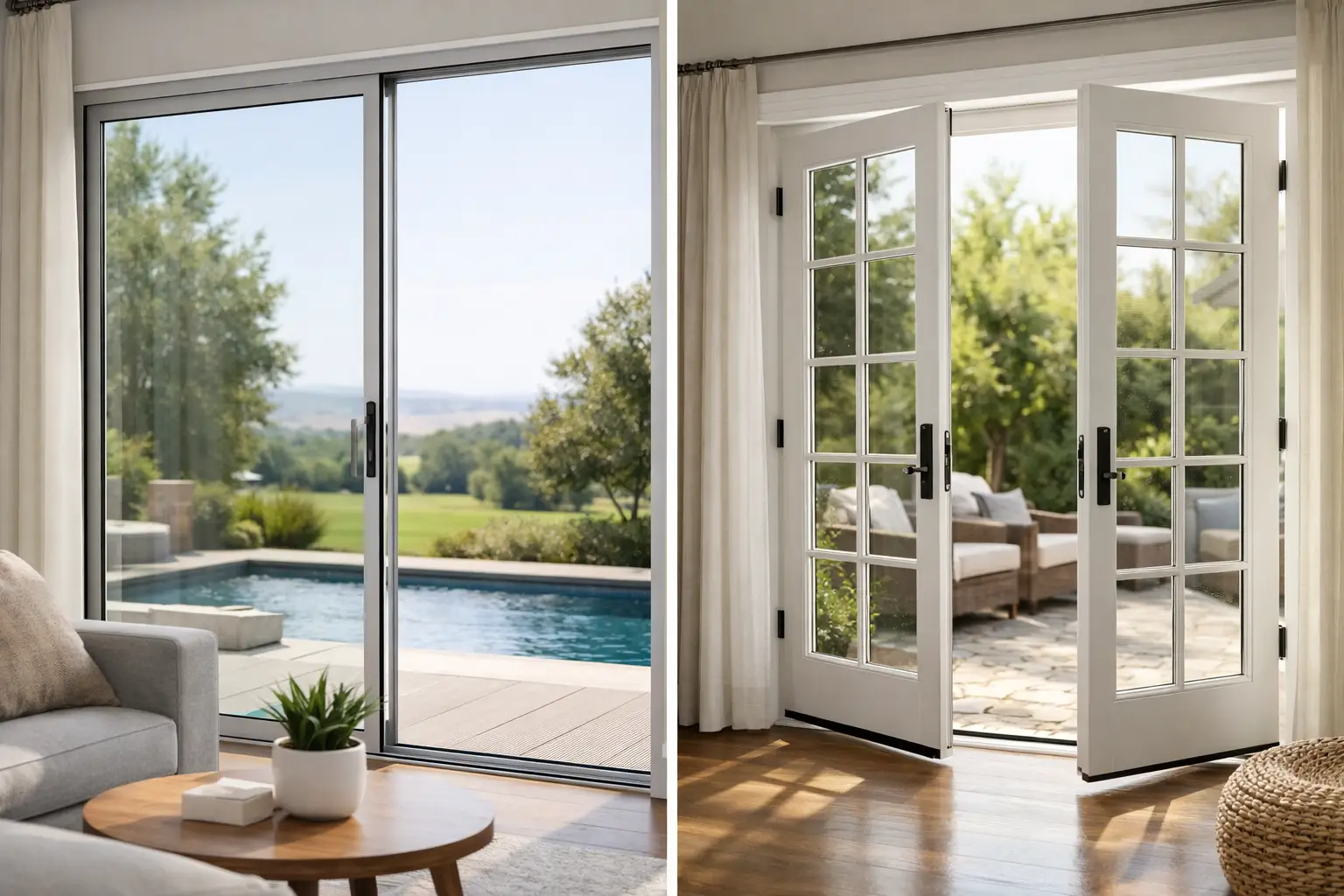
If you are weighing up sliding doors vs french doors for an extension, kitchen renovation or garden room, the right answer usually comes down to how you want the space to work day to day. Both can open a room to the garden and bring in far more light than older back doors, but they do it in very different ways. One gives you large glazed panels and a contemporary look. The other offers a more traditional feel with a full central opening.
For many projects, this choice is less about which door is better in absolute terms and more about which system suits the opening, the architecture and the way the household uses the room. That is where a proper comparison matters.
Sliding doors vs french doors: the main difference
The core difference is simple. Sliding doors move horizontally on a track, with one or more panels gliding behind another. French doors are side-hinged doors that open inwards or outwards from the centre or from one side.
That affects almost everything else, from sightlines and available opening width to furniture placement and traffic flow. Sliding doors are usually chosen for wider apertures and a cleaner, more minimal appearance. French doors suit smaller openings well and remain a strong option where a classic look is part of the brief.
In aluminium systems especially, sliding patio doors can achieve larger glass areas with slim frames and strong thermal performance. Premium systems such as the Cortizo COR Vision Sliding Door, Cortizo COR Vision Plus Sliding Door, Schuco ASE60 Sliding Door, Schuco ASE80 Sliding Door and Smarts Visoglide Plus sliding door are designed for exactly that sort of modern glazed opening.
Which gives you better views and more light?
If maximising glass is the priority, sliding doors usually come out ahead. Because the panels do not need the same type of hinged sash arrangement as French doors, the frame profile can often be kept visually lighter across a large opening. On a rear extension, that can make a noticeable difference to the amount of sky, garden and natural light you see from inside.
French doors still provide good light levels, especially in smaller openings, but they introduce more visible framing through the meeting stiles and outer frame. In a period property or a more traditional renovation, that detailing may actually be part of the appeal. In a contemporary extension with large-format glazing and flat roof lights, it can look more segmented than many homeowners want.
This is why architects and self-build clients often lean towards sliding systems when trying to create a sharper inside-outside connection. A large pane with slim aluminium sightlines simply gives a more open visual result.
Space planning matters more than many buyers expect
One of the most practical differences between sliding doors and French doors is the way they use space. Sliding panels stay within their own footprint, so you do not need clearance for leaves to swing open. That can be useful where furniture sits near the opening, where a dining table is close to the doors, or where an external terrace layout needs to stay uninterrupted.
French doors need swing space. If they open inwards, you need to keep the internal floor area clear. If they open outwards, you need to think about patio furniture, planting and wind exposure. None of that makes French doors a poor option, but it does mean they can be less forgiving in compact spaces.
On the other hand, French doors can give you a fully clear opening across the width of the set when both leaves are open. With a standard two-panel sliding door, only around half the opening is clear at any one time. If your priority is creating an unobstructed walkway for entertaining or regular garden access, that is worth considering.
Style: modern minimalism or familiar character?
This is often where the decision becomes clearer. Sliding doors suit modern homes, contemporary extensions and renovation schemes where clean lines matter. They work particularly well alongside aluminium windows with slim profiles, such as Cortizo Casement Windows or Schuco AWS80SC Casement Windows, helping create a consistent external elevation.
French doors are more versatile stylistically than many people assume. They fit traditional homes naturally, but they can also work in modern properties where the opening is modest and the design brief does not require expansive glazing. They often feel more domestic and familiar, which some homeowners prefer for everyday access points.
If your project includes large fixed glazing, roof lanterns or a pared-back aluminium aesthetic, sliding doors usually integrate more naturally. If you are upgrading an existing rear door opening in a cottage, townhouse or conventional family home, French doors may feel more proportionate.
Thermal efficiency and weather performance
Buyers quite rightly look closely at thermal performance now, especially on larger glazed openings. The good news is that both quality sliding doors and quality French doors can perform well when specified properly. The real issue is not door type alone. It is frame material, thermal break design, glazing specification, weather sealing and installation standard.
Modern aluminium systems with polyamide thermal breaks and energy-efficient double or triple glazing can achieve strong results in UK conditions. A well-made sliding door from an established system house can offer excellent weather resistance and insulation, while still delivering slim sightlines. French doors can also perform very well, particularly on smaller spans where achieving airtightness is more straightforward.
Where sliding systems have improved significantly is in their ability to combine larger glass panels with credible thermal values. That was not always the case. On a premium product, there is no reason to assume you must sacrifice efficiency to gain wider views.
Security and long-term confidence
Security should not be treated as a secondary feature. Patio doors are a major access point, and the quality difference between basic and well-engineered systems is substantial.
Both sliding doors and French doors can be specified with multi-point locking, toughened or laminated glazing, secure hardware and tested frames. The important thing is to choose an approved system, manufactured correctly, with the right components rather than a door assembled to chase a low headline price.
French doors are familiar to most buyers and generally feel straightforward from a locking point of view. Sliding doors rely on well-designed tracks, interlocks and locking points to deliver the same confidence. On premium aluminium systems, this is a solved problem, but product quality matters. So does installation. A high-performance door fitted poorly will never perform as intended.
Cost: which is better value?
French doors are often the lower-cost option for smaller openings. The design is simpler, the overall size is typically more modest and the hardware arrangement is usually less complex than a large sliding system. If budget is tight and the opening is not especially wide, French doors can make good financial sense.
Sliding doors tend to cost more, particularly when you move into larger panes, premium rollers, slim interlock sections and higher-spec glazing. That said, they are not directly comparable in every case. Many people choosing sliding doors are not simply replacing a pair of hinged garden doors. They are creating a much wider opening and changing the whole feel of the room.
So the better question is not always which is cheaper. It is whether the visual gain, extra glass and improved layout justify the additional spend. On many extension projects, they do.
Best use cases for each option
Sliding doors usually make more sense where the opening is wide, the garden view is a major selling point, and the project aims for a contemporary finish. They are especially strong in kitchen diners, rear extensions and open-plan living spaces where slim sightlines and easy furniture placement matter.
French doors are often the better fit for narrower openings, more traditional homes, side returns, utility spaces or projects where a full-width opening is preferred over large fixed glass panels. They also suit homeowners who want a simpler and more familiar door format without moving into a wider glazed system.
There is also a middle ground. Some buyers comparing sliding doors vs french doors are actually trying to solve a broader question about opening style. In those cases, bifold doors may enter the conversation too, with systems such as Smarts Visofold 1000 Bifold Doors, Cortizo Bifold Plus or Origin OB49 Bifold Doors offering yet another balance of opening width, framing and day-to-day use.
So which should you choose?
Choose sliding doors if your priority is glass, view, clean design and efficient use of floor space. They are the stronger option for larger apertures and modern aluminium-led schemes.
Choose French doors if the opening is smaller, the property leans traditional, or you want a practical garden door with a lower starting cost and a fully clear opening when both leaves are open.
The best results come from matching the system to the project rather than forcing the project around the door. Size of opening, orientation, threshold detail, glazing spec, security level and installation quality all matter just as much as the operating style. If you compare products properly and think about how the room will function in real life, the right choice usually becomes obvious quite quickly.
The door you notice least when living with it is usually the one you chose well.