
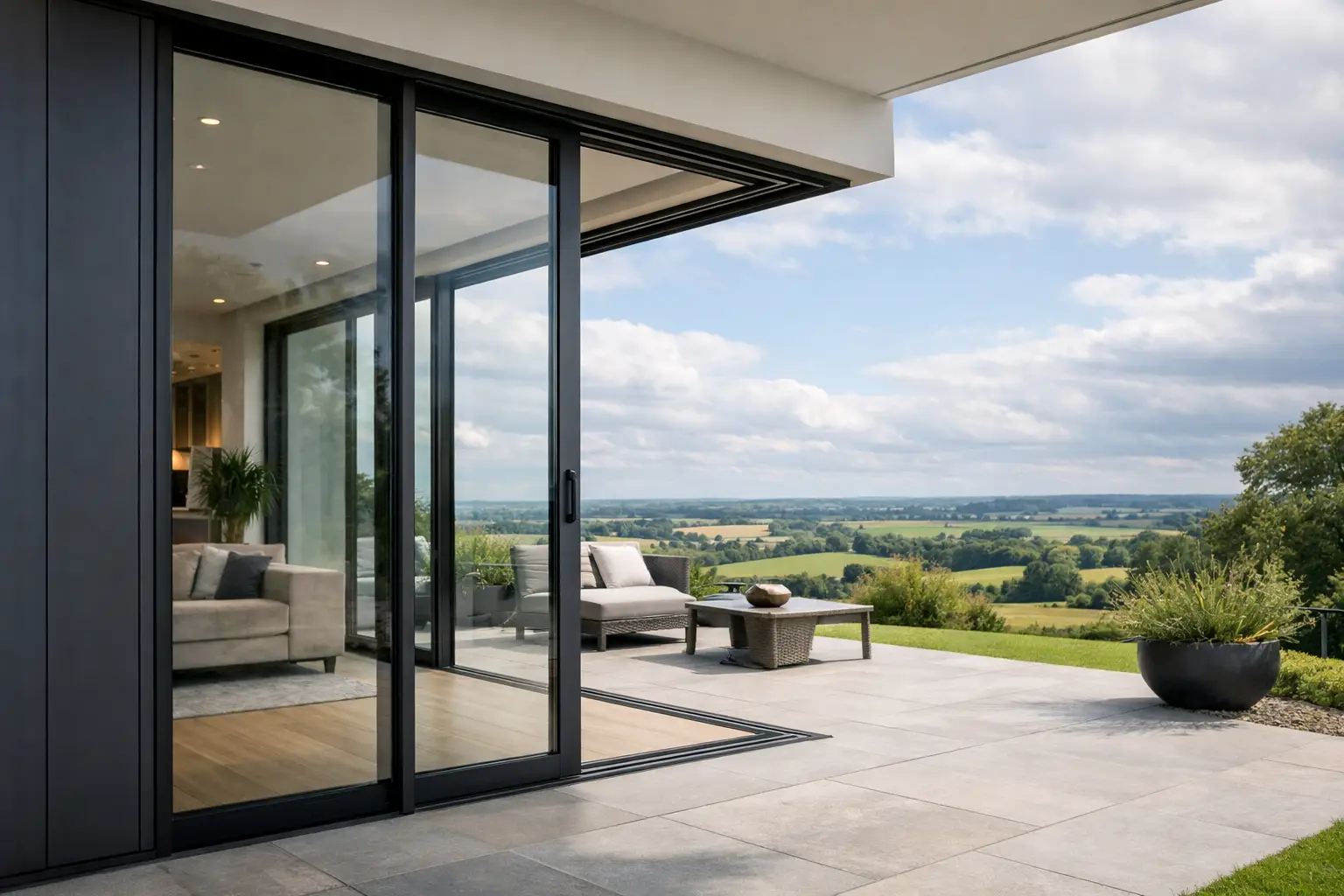
A sliding door can look exceptional in a showroom yet feel wrong on site if the panel sizes, threshold, glass specification and opening layout have not been properly considered. This Schuco ASE review looks at what the system offers in a real UK renovation or self-build project, and where it sits against other premium aluminium patio doors.
Schuco ASE is not a budget patio door range. It is specified by buyers who want refined aluminium profiles, dependable operation and strong thermal performance without compromising the glazed area. The key question is whether that investment is justified for your opening, rather than whether Schuco is a good brand in isolation.
What is the Schuco ASE sliding door system?
ASE refers to Schuco’s aluminium sliding door platform, available in versions including the Schuco ASE60 Sliding Door and Schuco ASE80 Sliding Door. The number broadly relates to the frame depth and the performance potential of the system, with the ASE80 generally chosen where enhanced insulation, larger expanses of glass or a more demanding specification is required.
Both systems are designed for contemporary projects where narrow visible aluminium, large glass panels and easy access to a garden, terrace or balcony matter. They can be configured as two-, three- or four-panel arrangements, depending on the opening and required direction of travel. Fixed panes can sit alongside sliding sashes to create wider glass walls without making every panel movable.
This flexibility is a genuine strength. A good sliding door should be designed around how the room is used: where furniture will sit, which section needs daily access, how much clear opening is wanted in summer, and whether a corner opening is part of the architectural design.
Schuco ASE review: the main reasons to specify it
Clean sightlines for modern extensions
The main visual appeal of Schuco ASE is its slim, well-proportioned aluminium framing. Compared with a bifold door, a sliding system has fewer vertical breaks across the view when closed. That makes it particularly effective for a rear extension overlooking a garden, an elevated view, or a large opening where uninterrupted glazing is the priority.
The actual sightline depends on the chosen arrangement, mullions, panel sizes and whether an interlock detail is used. It is therefore better to compare drawings for your exact design than to choose on a headline measurement alone. A two-panel door and a four-panel door may use the same system but deliver a very different visual result.
Thermal performance suited to British weather
Schuco ASE profiles use a thermal break, which separates the internal and external aluminium sections to reduce heat transfer through the frame. Combined with energy-efficient double or triple glazing, correctly specified warm-edge spacer bars and good installation detailing, this helps create a thermally efficient glazed opening.
The door alone does not determine how warm the room will feel. Glass specification, panel dimensions, orientation and the surrounding building fabric all influence the final outcome. South-facing glass can bring useful solar gain in cooler months, but it may also need solar-control glass or shading to limit overheating in summer.
For many refurbishment projects, a well-specified double-glazed unit offers an effective balance of cost, weight and performance. Triple glazing can improve insulation further, but it adds weight and may not be necessary for every opening. It should be considered as part of the whole design, not selected simply because it sounds like the higher-spec option.
Smooth operation with large panels
A premium sliding door should not require a hard pull or a dramatic shove to move. Schuco ASE is designed to support substantial glazed panels while retaining controlled sliding action, provided the door is manufactured, glazed and installed accurately.
That proviso matters. Large glass panels are heavy, and track alignment is unforgiving. Poor foundations, an uneven threshold or fitting the frame before the structure has settled can affect any sliding system. This is one reason experienced installation and proper preparation are as important as the product name on the frame.
Security and weather resistance
A Schuco sliding door can be specified with multi-point locking, secure hardware and toughened or laminated glass options where required. The finished door should be designed around the applicable security and Building Regulations requirements for the project, rather than relying on a generic description of ‘secure’.
For exposed sites, weather performance deserves equal attention. Drainage paths, seals, threshold detail and correct installation all affect how a door handles wind-driven rain. A flush-looking threshold can be an excellent design feature, but it must be planned carefully to manage water and achieve suitable levels between internal and external finishes.
ASE60 or ASE80: which is the better choice?
The Schuco ASE60 Sliding Door is often a strong option for standard residential patio door openings where premium appearance and good thermal performance are required without moving to the deepest system. It can suit extensions, kitchen-diners and replacement projects where panel sizes are sensible and the budget needs to remain controlled.
The Schuco ASE80 Sliding Door is generally the more capable choice for larger glass panels, ambitious architectural openings and projects where enhanced thermal performance is a priority. Its deeper construction can make it better suited to specifications that would push a lighter system too far.
Neither is automatically ‘better’. For a modest two-panel opening, ASE80 may add cost and profile depth without a meaningful benefit. For a wide three- or four-panel elevation, selecting a system with sufficient capacity from the outset can avoid design compromises later. The right comparison starts with panel widths and heights, glass build-up, location and opening configuration.
Where Schuco ASE compares well with alternatives
Schuco ASE is often compared with the Cortizo COR Vision Sliding Door and Cortizo COR Vision Plus Sliding Door, as well as other premium aluminium slider systems. All can create impressive glass areas, but they do not offer identical profile proportions, panel limitations, threshold details or price points.
Cortizo systems are frequently selected where a very minimal architectural appearance is the driving factor. Schuco ASE appeals to buyers looking for a highly engineered system with a broad choice of practical residential configurations. The best option depends on the look you want, the required structural performance and the budget available for the full installation, not just the frame.
It is also worth comparing sliding doors honestly with bifolds. A Schuco ASFD75 Bifold Door or Origin OB49 Bifold Door can open a larger percentage of the aperture, making it more suitable where a fully open connection to the garden is the priority. A slider usually leaves part of the opening occupied by a fixed or stacked panel, but provides cleaner views when shut. Many projects benefit from sliders across the main view and a separate access door or bifold on a secondary elevation.
Points to check before ordering
Before committing to Schuco ASE, ask for the door to be quoted as a complete specification. The most useful quotation confirms the overall frame size, number of panels, opening direction, glass type, colour inside and out, handle finish, threshold detail and installation scope. It should also make clear whether structural steel, making good, drainage preparation or removal of existing doors is included.
Pay particular attention to the proposed glass. Floor-to-ceiling doors may require safety glazing, and wide panels can alter the unit weight considerably. Privacy glass, solar-control coatings and acoustic glass are worthwhile upgrades in the right setting, but each can affect appearance, cost and thermal or solar performance.
Colour deserves more thought than it receives. Anthracite grey remains popular, yet black, textured finishes and dual-colour frames can better match a property’s windows, brickwork and interior scheme. A contrasting internal colour can work well in a light room, but it should be selected alongside the handles, flooring and kitchen finishes rather than from a small swatch alone.
Finally, decide early whether you need supply only or supply and installation. Trade buyers may have an established fitting team and want a clearly manufactured, correctly packaged system. Homeowners and self-builders often gain more confidence from a surveyed and installed package, particularly for large or complex openings. Bifolding Door Factory supports both routes, with employed installation teams for projects that require full fitting.
Is Schuco ASE worth the price?
For a homeowner replacing a small, lightly used patio door, Schuco ASE may be more system than the project needs. There are capable aluminium alternatives at a lower price point. But for a substantial extension, high-value renovation or self-build where the sliding doors are a defining architectural feature, the quality of the profiles, hardware and glazing specification can be money well spent.
The value is clearest when the system is used within its strengths: generous glazed openings, carefully planned panel sizes, high-performance glass and accurate installation. Do not judge it only by a per-square-metre figure. A patio door is one of the most visible and frequently used components in the home, so the view, feel of operation and long-term weather performance all deserve a place in the decision.
Bring your proposed opening dimensions, photographs and preferred layout to the quotation stage. A detailed comparison of ASE60, ASE80 and suitable alternatives will show which door gives you the view and performance you want without paying for specification you will never use.