
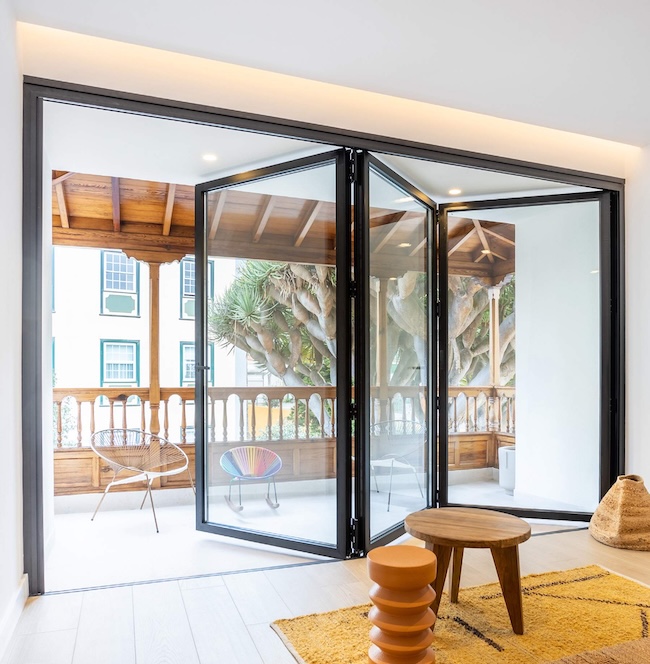
Category: Bifold doors
If your doors have started catching on the threshold, rubbing at the frame or refusing to line up cleanly when they close, you are probably looking for how to adjust aluminium bifold doors that have dropped rather than replace anything outright. In many cases, a dropped sash or misaligned leaf is an adjustment issue, not a product failure – but the right fix depends on where the movement has happened.
Aluminium bifold doors are engineered systems, not just a set of panels on hinges. Whether you are dealing with Smarts Visofold 1000 Bifold Doors, Schuco ASFD75 Bifold doors, Cortizo Bifold Plus or Origin OB49 Bifold Doors, the principle is similar. Weight is carried through rollers, hinges, carriers and track hardware, and even a small shift can affect operation across the whole set.
Why aluminium bifold doors drop in the first place
A bifold door does not usually “drop” for no reason. More often, one of three things is happening. The first is normal settlement and bedding in, particularly on newer installations where the building opening, has taken up load during the first months of use. The second is hardware movement, where hinges, rollers or carriers have moved slightly out of adjustment. The third is a more structural issue, such as frame distortion, incorrect installation tolerances or threshold movement.
That distinction matters. If the problem is simple hardware alignment, adjustment is usually straightforward. If the outer frame is no longer square, winding rollers up and down may improve symptoms without solving the real cause.
Heavy glazed leaves also play a part. Large-panel systems with triple glazing, low thresholds or ambitious opening widths put more demand on the hardware than a modest three-panel set. Premium systems are designed for that load, but only when the door has been manufactured, packed and installed correctly.
Signs your bifold doors need adjustment
The most common sign is contact where there should be clearance. You may notice the lead door scraping the cill, a panel clipping the head, magnets no longer meeting properly, or locks needing a push or lift before they engage. Sometimes the doors still open, but feel heavier than usual or fail to stack neatly.
Another clue is uneven sightlines. If the gap at the head between the door sash and frame is not parallel, or the meeting stiles are no longer parallel, that points to alignment drift. Water ingress and draughts can also appear if compression seals are no longer meeting evenly.
How to adjust aluminium bifold doors that have dropped
Before touching any adjustment point, start with the basics. Open and close the full set slowly and watch exactly where contact happens. A panel rubbing at the threshold needs a different correction from a lead door that will not lock at the top. Clean the track first, because grit and debris can mimic a dropped door.
Some aluminium bifold systems allow adjustment in the rollers, hinges or both. The exact hardware varies by manufacturer, so always check the installation manual for your system if you have it. On many doors, the main vertical adjustment is made at the bottom rollers or carriers using an Allen key. Turning the adjuster raises or lowers the affected leaf slightly.
Work in small increments. A quarter turn can be enough to change how the whole set sits. After each adjustment, cycle the doors fully open and closed. If you make several changes at once, it becomes harder to see which one helped and which one made alignment worse.
The most common issue when doors rub the bottom of the frame or the lock becomes difficult to operate is the doors need toe & heal packing on the glass. Some doors have a hole on the top of the door approx 75-100mm from the edge inside this hole there is an allen key adjuster. Turn an allen key clockwise and one full 360 degree rotation will lift the door on the glass 1mm. Installers will remove the glazing gasket and shim the glass whilst this is a good option it is not suggested that the untrained public attempt this due to the risk of breaking glass and personal injury.
Adjusting the bottom rollers or carriers
If the panel has dropped and is rubbing on the threshold, the bottom roller adjustment is usually the first place to look. Locate the access point on the carrier or roller assembly, then raise the panel carefully. On most systems, you are not trying to create a visible gap everywhere – you are trying to restore even clearance and proper operation.
Be mindful that lifting one leaf can affect the panel next to it. On bifolds, the leaves work together, so the goal is not to perfect one panel in isolation. If the stack now runs better but the lead door no longer aligns with the frame, you may need a secondary hinge adjustment.
Adjusting the hinges
Some dropped-door issues show up more as sideways misalignment than vertical sag. In that case, the hinges may need lateral or compression adjustment. This helps where panels are touching each other, the gasket pressure is uneven or the lead door is not meeting the lock keep correctly.
Again, minor changes are best. Adjust one hinge position at a time and check the effect with the doors fully closed and locked. If the lock engages only when you lift the handle hard or push the panel inward, that suggests alignment rather than a failed lock.
Checking the lead door alignment
The traffic door or lead door often shows problems first because it is the most used panel. If it has dropped, locking points may miss the keeps at the head or cill. In some systems, the keeps can be adjusted slightly; in others, the door leaf position must be corrected first. Moving keeps to compensate for a sagging panel is rarely the best first move.
If the lead door is square but still tight, inspect the handle operation and shoot bolts. Dirt, wear or poor lubrication can add resistance that feels like a dropped door. Use a suitable non-corrosive lubricant on moving parts, but avoid over-applying product into tracks where it attracts debris.
When adjustment will not solve it
There are situations where learning how to adjust aluminium bifold doors that have dropped only gets you part of the way. If the frame is out of square, the threshold has deflected, the fixing points have moved or the glass has not been packed correctly within the sash, the hardware may be compensating for a deeper fault.
Misted units, cracked glazing beads, loose hinges or visibly bowed frames are not routine adjustment jobs. Nor is persistent dropping that returns after a short period. That usually points to wear, under-specification, incorrect installation or an unresolved structural movement in the opening.
This is where system quality matters. A properly specified aluminium bifold from an established range such as Smarts Visofold 6000, Schuco ASFD75 Bifold doors or Origin OB36 Bifold Doors should give stable long-term performance, provided the manufacturing tolerances, glazing packers and installation details are right from the outset.
Common mistakes to avoid
The biggest mistake is over-adjusting. It is easy to keep turning adjustment screws until one issue disappears, only to create a new one somewhere else. Bifold doors need balanced alignment across the entire set.
Another common problem is assuming every rub mark means the leaf needs lifting. Sometimes the roller height is fine, but the panel is pulling sideways at the hinge side. Sometimes the frame itself has moved slightly and the correct remedy is not at the panel at all.
Forcing the handle is equally unwise. If the locking points are misaligned, extra force can damage keeps, handles or gearbox components. That turns a service adjustment into a parts replacement.
Should you adjust them yourself or call a specialist?
If your doors are only slightly out and you are confident with hand tools, a careful adjustment may be reasonable, especially if you know the door system and have access to the correct manual. For a homeowner, the safe line is simple: light adjustment, yes; diagnosis without certainty, no.
Trade professionals and experienced installers will usually recognise whether the issue is hardware, packing or frame geometry within a few minutes. For homeowners, the risk is not the Allen key itself – it is missing the underlying cause.
If the doors are under warranty, always check the terms before attempting anything beyond basic maintenance. Unauthorised adjustment or dismantling can create unnecessary complications. That is particularly relevant on premium branded systems where approved components and documented installation standards are part of the value.
Preventing the problem from returning
Routine care helps more than many owners realise. Keep the tracks clean, check drainage points remain clear and operate the doors properly rather than dragging them from one panel. Large bifolds should feel controlled in use, not rushed.
It also pays to act early. A slight rub today is usually easier to correct than a set that has been forced for six months. If you are specifying new doors for an extension, material quality, panel size, threshold choice and installation standard all influence long-term adjustment stability. That is one reason specialist suppliers and employed installation teams matter – the product is only as good as the way it is set, packed and handed over.
A well-made aluminium bifold door should close with precision, not persuasion. If yours has started to drop, treat it as a sign to investigate properly, make measured adjustments where appropriate, and bring in a specialist when the issue points beyond normal hardware tuning.