
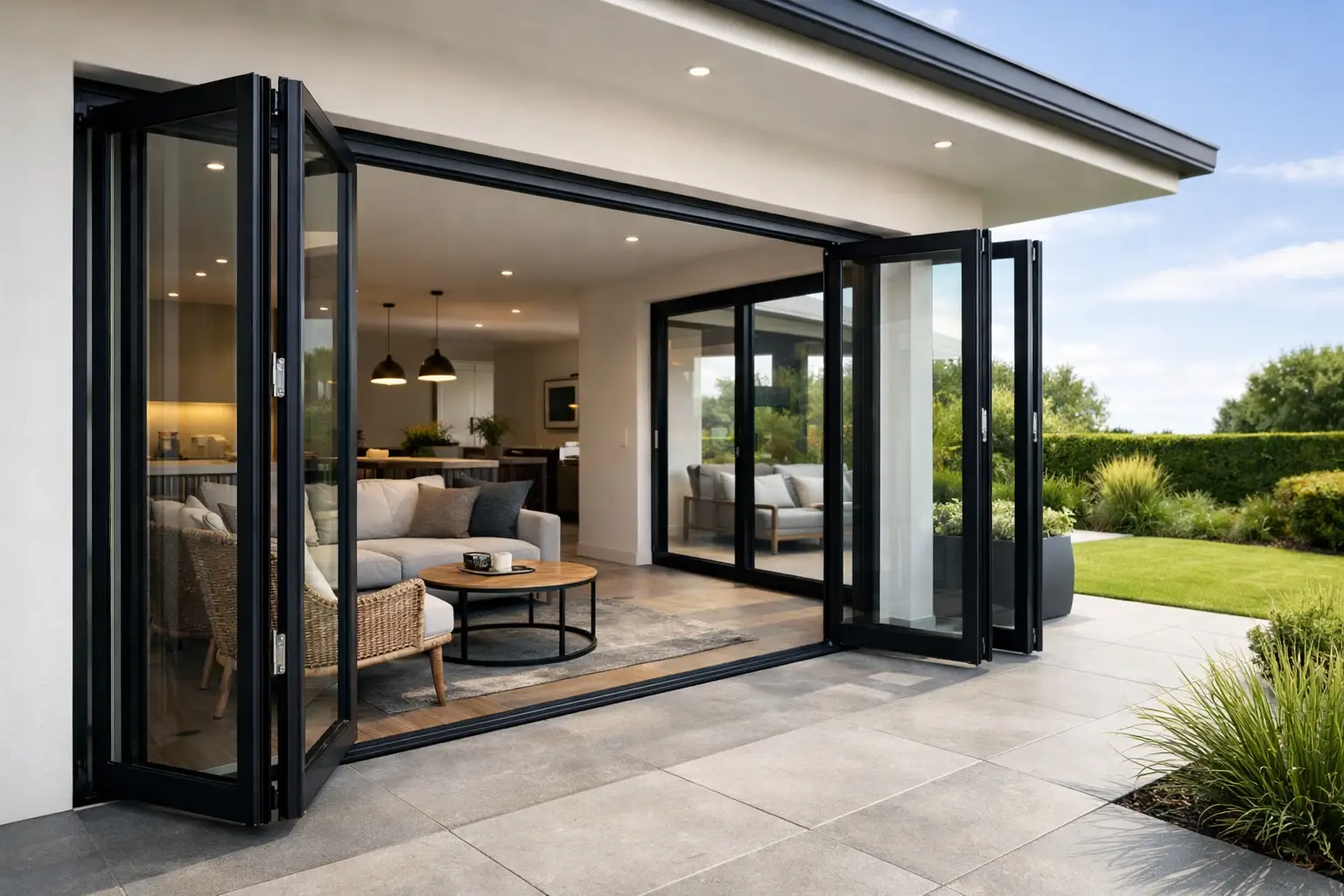
A rear extension can look excellent on plan and still feel underwhelming once built. The usual reason is simple – the opening is too mean, the frames are too heavy, or the doors never quite connect the house to the garden. External bifold doors solve that problem when they are specified properly, giving you a wide, usable opening, strong sightlines and the kind of everyday practicality that matters long after the build is finished.
For homeowners, that usually means more light, better access and a cleaner, more contemporary finish. For builders, architects and self-build clients, it means balancing aesthetics with structural opening sizes, threshold detail, thermal performance, security and budget. Good bifold doors are not just about folding panels. They are about how the full system performs in British weather, how it looks closed, and how reliably it works over time.
Why external bifold doors remain a strong choice
There is a reason bifolds continue to be specified across extensions, renovations and new-build homes. When closed, they create a large glazed screen with slim aluminium framing and generous glass area. When open, the panels stack away to one or both sides, opening up far more of the aperture than a typical set of French doors or many sliding systems.
That wide opening is the real attraction. If your priority is entertaining, garden access or making a kitchen extension feel connected to a patio, external bifold doors can do something sliding doors cannot always match. A sliding door keeps larger panes visible at all times and often gives slightly slimmer uninterrupted sightlines, but only part of the opening will ever be clear. With bifolds, most of the opening can be used.
The trade-off is straightforward. Bifolds have more moving parts, more frame lines and more decisions to make. Panel sizes, opening direction, traffic doors, thresholds and sightlines all affect the result. That is why system choice matters.
Choosing the right external bifold doors
Not all aluminium bifolds are built to the same brief. Some suit cost-conscious projects where dependable performance and sensible styling are the priority. Others are aimed at higher-end builds where slimmer profiles, larger sash sizes or enhanced thermal specifications justify the extra spend.
Systems such as Smarts Visofold 1000 Bifold Doors and Smarts Visofold 6000 remain popular because they offer proven aluminium construction, practical configuration options and a look that suits a wide range of homes. If the project calls for a more premium architectural feel, Schuco ASFD75 Bifold doors and ASFD90.Hi Bifold Doors are often specified for their engineering quality, refined detailing and strong overall performance. Cortizo Bifold Plus is another strong option where slim aesthetics and contemporary styling are central to the design. For buyers who value British manufacturing and a broad choice of hardware and finishes, Origin OB36 Bifold Doors and Origin OB49 Bifold Doors are also regularly considered.
The right answer depends on the opening, the target budget and what matters most visually. If you are trying to maximise glass and minimise visible aluminium, some systems will be stronger than others. If you need a specific panel arrangement or very practical day-to-day access, that can narrow the field quickly.
Panel configuration matters more than many buyers expect
A bifold is only as practical as its layout. Three-panel and four-panel arrangements are common for smaller and mid-sized openings, while five, six and seven-panel sets are often used across wider extensions. The obvious temptation is to focus on how the doors look when fully open, but daily use usually tells a different story.
Most households use the traffic door far more often than the full set. That single access leaf lets you move in and out without folding back the entire system, which is particularly useful in winter or on rainy days. Get that wrong and the doors may still look good, but they will be less convenient than they should be.
Opening direction also affects furniture layouts, internal circulation and external use of patio space. It needs thinking through early, not added as a late-stage sales option.
Thermal performance, weathering and security
A modern aluminium bifold should never be judged on looks alone. External bifold doors have to cope with exposure, repeated use and large glazed areas without becoming a weak point in the building envelope.
Thermally broken aluminium frames and energy-efficient glazing are central here. They help reduce heat loss while keeping the slim, strong profile that makes aluminium so well suited to larger openings. Glazing choice also plays a part. Double glazing is standard for many projects, but specification can vary depending on orientation, exposure and overall performance targets. Solar control glass may be useful on south-facing elevations where overheating is a concern, while upgraded low-emissivity glass can support better thermal efficiency.
Weather performance matters just as much. In the UK, wind, driving rain and repeated temperature changes are not theoretical issues. They are part of normal service life. A well-made, correctly installed bifold system should be tested for air permeability, watertightness and wind resistance, and the installation quality needs to match the product quality. Even an excellent door can disappoint if the survey, tolerances or threshold detailing are poor.
Security is another area where system quality matters. Multi-point locking, quality hardware, toughened or laminated glass where appropriate, and tested system components all contribute to a safer finished door set. For many buyers, this is where premium branded systems justify their position.
Bifold vs sliding doors
This is one of the most common comparisons on modern extension projects, and there is no single right answer. External bifold doors are usually chosen for the size of the opening they can create. If your priority is stepping straight out to the garden with minimal obstruction, bifolds make a strong case.
Sliding doors are often preferred when uninterrupted views are the priority. Systems such as the Smarts Visoglide Plus sliding door, Schuco ASE60 Sliding Door, Schuco ASE80 Sliding Door, Cortizo COR Vision Sliding Door and Cortizo COR Vision Plus Sliding Door can offer larger panes and fewer vertical frame breaks. They tend to look particularly strong on wider spans where the doors will often remain closed.
So it comes down to use. If you want to open up most of the aperture in warm weather, bifolds are usually the better fit. If you want a cleaner glazed wall with fewer sightlines and do not mind that only part of the opening slides back, a sliding system may suit the architecture better.
Design details that shape the finished result
Threshold choice has a big impact on both appearance and practicality. A low threshold improves accessibility and helps create a cleaner transition to outside, but exposure and site levels need careful consideration. A more weather-rated threshold may be the smarter option on exposed elevations, even if it is slightly less flush.
Colour is another decision that should be made with the wider scheme in mind. Anthracite grey remains popular because it works with brick, render and contemporary extensions, but it is far from the only choice. Black, white and dual-colour options all have their place, and premium powder-coated finishes can make a noticeable difference to the overall feel of the doors.
Hardware also deserves more attention than it usually gets. Handles, hinges and the quality of running gear influence not just appearance, but how solid and refined the doors feel every day. Better systems tend to show their value here over time.
What affects the price of external bifold doors?
Price depends on more than width and height. System brand, panel count, glazing specification, colour, threshold type, hardware upgrades and installation complexity all influence cost. A straightforward supply-only order for a standard-sized opening is one thing. A large opening requiring steel coordination, upgraded glass and full installation is another.
That is why transparent, like-for-like comparison is so important. A cheaper quote can look attractive until you realise it excludes upgraded glazing, uses a different threshold or is based on a less capable system. Buyers comparing Smarts, Schuco, Cortizo and Origin should be looking at the whole package, not just the headline figure.
For trade professionals, dependable lead times, accurate manufacturing and approved system components are often as valuable as the initial price. For homeowners, confidence in survey, installation and aftercare can matter just as much.
Installation is part of the product
A bifold door is not a commodity item that performs the same in every setting. Survey accuracy, structural opening preparation, packers, fixing methods, perimeter sealing and final adjustment all affect the result. That is why supply-only and supply-and-install are different propositions, even when the product is identical on paper.
Where installation is included, experienced employed teams offer a clearer line of accountability and consistency than loosely managed subcontract arrangements. On larger openings especially, that matters. A premium aluminium system should feel precise in operation, sit correctly in the aperture and finish cleanly against surrounding materials.
For self-builders and builders buying supply-only, detailed technical support is still valuable. It helps avoid site issues that cost time later.
If you are comparing external bifold doors for a project, start with how you want the opening to work, not just how you want it to look. The best result is usually the one that gets the configuration, system quality and installation standard working together. Done properly, bifolds do more than open a wall – they make the whole room perform better.