
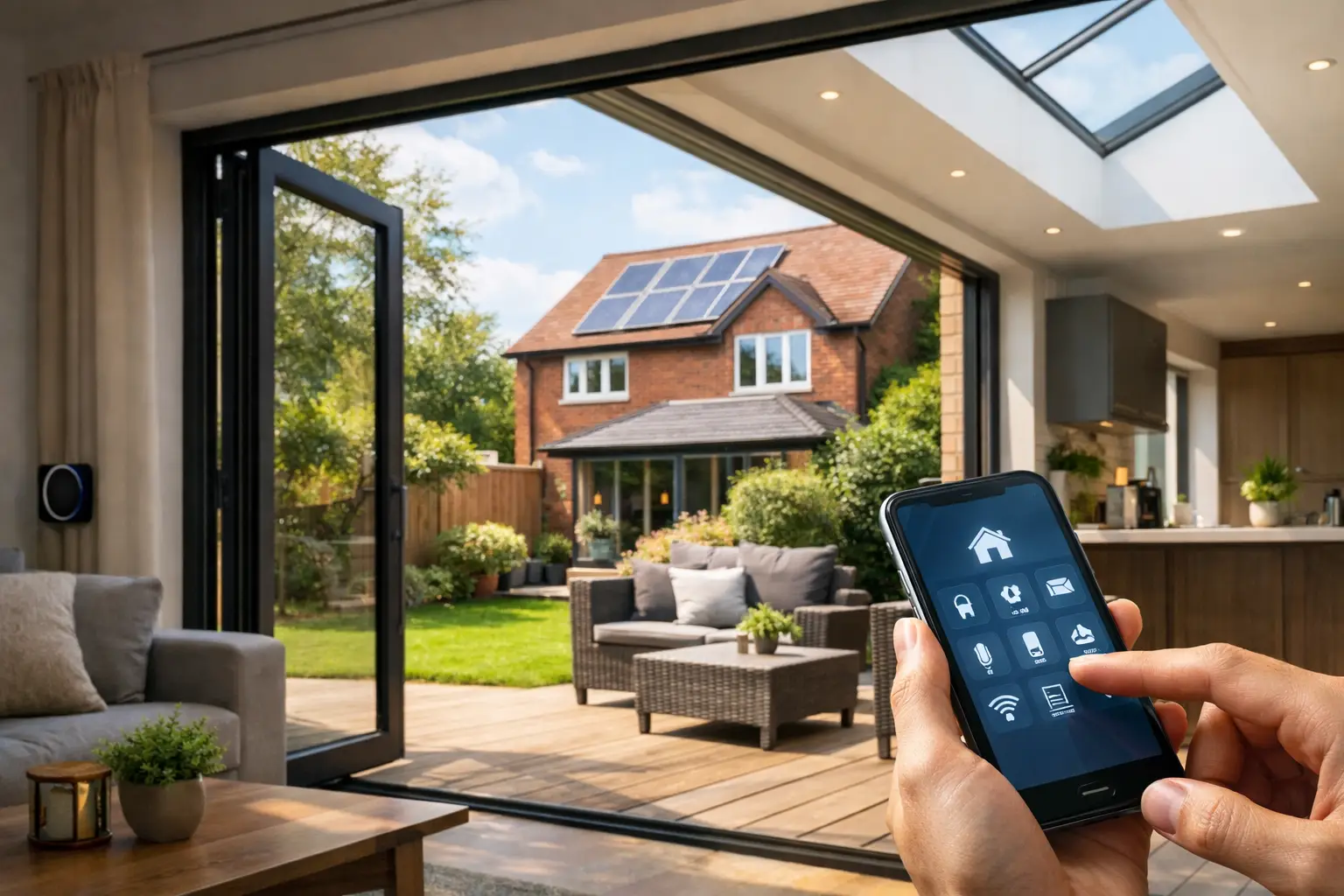
A south-facing extension can feel bright and uplifting in March, then uncomfortably hot by the first warm spell of summer. Smart home glazing gives homeowners more control over that experience – helping manage solar gain, privacy, glare and heat loss without compromising the slim aluminium frames and large glass areas that make a project feel special.
For a renovation or self-build, though, the term needs careful handling. Smart glazing can mean electronically controlled glass, but it is also used more broadly for high-performance glazing combined with automated blinds, sensors and connected heating controls. The right answer depends on the orientation of the property, the size of the opening, planning requirements and how the room will actually be used.
What is smart home glazing?
Smart home glazing refers to glass and glazed systems that respond to changing conditions or can be adjusted by the homeowner. In its most advanced form, the glass itself changes its tint or opacity. In a wider, practical sense, it includes solar-control units, integrated blinds and automated shading that work alongside high-performance aluminium doors, windows and roof glazing.
For most UK projects, the aim is straightforward: maximise daylight and garden views while preventing a glazed extension from becoming too hot, too cold or too exposed. A quality double- or triple-glazed unit, paired with a thermally broken aluminium frame, remains the foundation. Smart features should solve a specific comfort issue rather than add complexity for its own sake.
Switchable privacy glass
Privacy glass uses a liquid crystal layer within the unit. When powered, it appears clear; when switched off, it turns translucent, obscuring the view while allowing light through. It is particularly effective for bathroom windows, internal partitions, street-facing side glazing and home offices where curtains would spoil a clean contemporary finish.
Its limitation is that privacy glass is not a replacement for solar-control glass. It diffuses the view, but it does not necessarily reduce solar heat gain to the level needed for a heavily glazed south or west elevation. It also requires an electrical connection and should be specified early, before frames, plasterboard details and control positions are finalised.
Electrochromic and solar-control glass
Electrochromic glass gradually tints in response to a switch, app or automated sensor. It can reduce glare and solar gain while retaining a view out, making it attractive for roof lights, lantern roofs and large sliding door installations. The tint transition is deliberate rather than instant, which suits daylight management but may not be ideal where immediate privacy is the priority.
For many homeowners, a fixed solar-control coating offers better value. It rejects a proportion of solar energy before it enters the room, reducing overheating risk while retaining good light transmission. The specification needs to be balanced carefully: glass with very high solar control can make a north-facing room feel noticeably darker, especially in winter.
Heated glass and connected comfort controls
Heated glass contains a near-invisible conductive coating that acts as a radiant heat source. It can reduce condensation around high-humidity spaces and may be useful where wall space for radiators is limited. It is a premium solution, best considered as part of the full heating design rather than an isolated door upgrade.
Sensors can also bring practical benefits. Sun sensors may lower automated blinds during the hottest part of the day, while temperature and humidity controls can support ventilation habits. These measures work best when the property also has appropriate opening windows, trickle ventilation where required, and a sensible approach to shading.
Smart home glazing starts with the frame and glass unit
Technology cannot compensate for a poorly specified glazed system. The thermal performance of a bifold, sliding door or window depends on the complete assembly: frame profile, thermal break, glass build-up, spacer bar, seals, installation detail and the junction with the building fabric.
Aluminium is a strong choice for wide openings because it supports slim sightlines and large panes without the bulk associated with other materials. Modern systems use thermal breaks to limit heat transfer through the frame. Combined with energy-efficient glazing, this creates a door or window that is suited to British weather, not just an attractive showroom feature.
The glass specification should be selected for its location. Low-emissivity coatings help retain internal heat. Argon-filled units and warm-edge spacer bars contribute to thermal performance. Laminated glass can improve security and acoustic performance, while toughened safety glass is required in critical locations. Where a road, railway or lively neighbourhood affects the project, acoustic laminated glazing may provide more day-to-day value than electronically tinting glass.
Where smart glazing adds the most value
Large roof glazing is often the first place to consider solar control. Roof lights receive more direct sunlight than vertical windows, so a beautiful lantern roof can create overheating if the glass is not matched to the orientation and room layout. Solar-control glass, opening roof vents or external shading may be appropriate depending on the design.
For wide patio openings, the question is usually whether the home needs a broad, open connection to the garden or the largest possible uninterrupted view. Products such as the Cortizo COR Vision Plus Sliding Door and Schuco ASE80 Sliding Door can accommodate substantial glass panels with refined sightlines. Adding solar-control glass is often sensible on south- and west-facing elevations, but the correct coating should preserve the clear appearance buyers expect from premium sliding doors.
Bifold doors bring a different benefit: they can fold back to open an entire aperture for entertaining and summer use. Systems such as Smarts Visofold 1000 Bifold Doors, Schuco ASFD75 Bifold doors and Origin OB49 Bifold Doors offer different profile designs, panel options and performance levels. Smart controls are usually less important here than reliable hardware, correct drainage, secure locking and glazing that keeps the room comfortable when the doors are closed.
Street-facing windows, bathrooms and overlooked plots are where switchable privacy glass has a clearer case. It avoids the permanent visual barrier of frosted glass and gives the owner control when privacy is needed. That flexibility can be valuable, although a carefully positioned Cortizo Hidden Sash Window or obscured lower pane may deliver the desired result at a lower cost.
Specify the whole project, not a single feature
A glazing package should be assessed alongside roof insulation, ventilation, shading, heating and the intended use of the room. A kitchen-diner used from breakfast through to evening needs a different solution from a north-facing garden room used occasionally. An architect may prioritise clean sightlines; a homeowner may be more concerned with glare on a television or privacy from neighbouring properties. Both considerations are valid.
Planning and Building Regulations also matter. Large areas of glazing affect heat loss, overheating calculations and safety requirements. On replacement projects, existing opening sizes and structural support can limit the choice of glass thickness or frame system. For new extensions, considering these factors before steelwork and roof details are confirmed avoids costly compromises later.
Installation quality is equally significant. Glass units must be correctly packed and supported within the frame, perimeter seals must be continuous, and interfaces with the building need to control water and air ingress. Electronic glass adds cabling, transformers and controls to that list, so the glazing installer and electrician need to work from an agreed plan rather than leaving connections as an afterthought.
Questions worth asking before you buy
Ask what the quoted U-value applies to: the glass centre pane, the frame or the complete door or window. Check the solar factor and light transmission if overheating or brightness is a concern. For automated products, establish how the system is controlled, what happens during a power cut, where components will be located and whether manual override is available.
It is also worth asking whether a standard high-performance glass specification, external blind or internal blind would achieve the same result more simply. Smart home glazing is most successful when it is chosen for a clear reason, not because it sounds more advanced.
A better view should also be a more comfortable room
The best glazed extensions feel effortless: bright without glare, warm in winter, manageable in summer and secure every day. That outcome comes from correctly sized, well-installed aluminium systems and glazing selected for the building, rather than from a single headline feature.
Whether you are comparing bifolds, sliding doors, windows or roof glazing, start with the orientation, performance target and how you want the space to feel. The smart choice is the specification that continues to work long after the novelty of the technology has passed.